
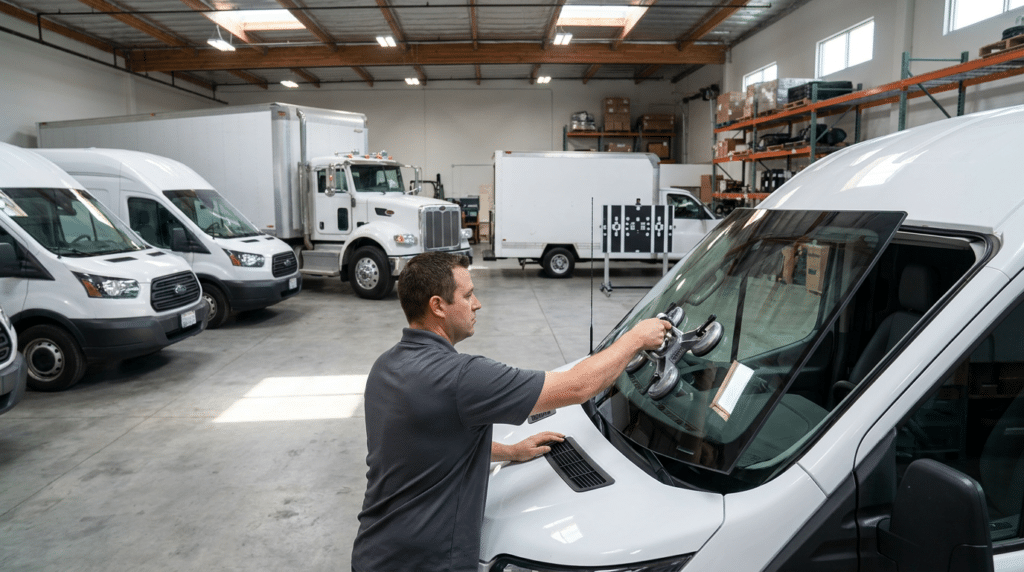
A small chip left unchecked in Utah’s summer heat can spread into a crack and create an unexpected dispatch headache.
At Two Bros Auto Glass, we offer mobile service, insurance claim assistance, and an emergency after-hours line for fleets. Call (801) 268-1204 to discuss damaged fleet windshields before assigning the next load.
Jump to a section
Count the full cost of glass damage
The replacement invoice is only part of a fleet’s glass expense. Include driver waiting time, vehicle transfers, and dispatch changes in the same calculation. A lower invoice may not represent the lower total cost if the truck misses work.
Start with costs you can document. Use payroll records, dispatch logs, and claim records rather than an assumed industry average. Your delivery vans and long-haul tractors have different earning patterns, so treat their downtime differently.
Separate cash expenses from lost capacity
Direct expenses include your share of the glass service, related calibration, and any transport needed for the appointment. Operational costs include paid waiting time and extra dispatch work. Lost capacity means work the vehicle could have performed but couldn’t because it remained unavailable.
Don’t count the same loss twice. If another truck completes a delivery, the original truck’s downtime doesn’t automatically equal lost revenue. Record the added transfer cost or overtime instead.
-
Service expense: Glass work, required calibration, and related charges.
-
Labor expense: Paid waiting, repositioning, and administrative time.
-
Route expense: Detours, load transfers, or substitute vehicle use.
-
Lost contribution: Missed revenue minus operating expenses you didn’t incur.
A windshield event log connects these expenses to a specific unit. That record underpins decisions about whether earlier attention would have been worthwhile.
Optimizing Fleet ROI with a measurable maintenance plan
A proactive program needs a baseline, not a promised savings percentage. Compare your fleet’s glass costs before and after introducing a consistent reporting and scheduling process. Keep vehicle type and seasonal exposure in view.
Return on investment means the financial benefit compared with the money spent to obtain it. For windshield maintenance, the benefit may include lower documented disruption costs. It isn’t simply the difference between a repair invoice and a replacement invoice.
Use a calculation your accounting team can defend
Subtract the added cost of the maintenance program from its documented financial benefit. Divide that net benefit by the added program cost to evaluate return. Treat estimated avoided costs separately from savings supported by actual records.
A fair comparison includes inspections, staff coordination, and repairs that weren’t previously scheduled. Leaving those costs out makes the program look stronger than the evidence supports.
Track glass expense per mile alongside total spending. A busier fleet may spend more overall while spending less per mile. Compare similar trucks and routes rather than mixing every unit into one average.
Measure decisions as well as dollars
Reporting speed and unscheduled stops reveal process gaps before annual spending tells the full story. Record when damage appeared, when it was assessed, and when service occurred. Note why a repair or replacement was recommended.
Don’t label every repaired chip an avoided replacement. Some damage may never have spread during your ownership period. Strong reporting distinguishes what happened from what you believe might have happened.
Results for auto glass repair and replacement can vary based on the initial damage severity, vehicle make/model, age of vehicle, and specific ADAS system configurations.
Turn driver reports into service decisions
Early reporting gives your fleet more scheduling choices. Build windshield checks into your existing vehicle inspection process instead of creating a separate task drivers will overlook. Drivers should report damage, not decide whether a chip meets repair criteria.
Utah’s summer heat and winter temperature swings can put added stress on damaged glass. Avoid treating a small mark as harmless because it hasn’t spread yet. Conversely, don’t assume every chip requires replacement.
Give dispatch useful information
A useful report identifies the unit and shows the damage in context. Ask for a close photo and a wider view showing its position on the windshield. Capture images only while safely parked.
-
Record the unit identifier and vehicle make and year.
-
Describe the damage location and any effect on the driver’s view.
-
Note spreading cracks, camera warnings, or recent glass work.
-
Provide the next planned parking location and dispatch window.
-
Send the report to the person authorized to arrange assessment.
The next step is professional assessment, not an automatic work order for the cheapest option. Damage depth, contamination, edge proximity, and visibility all affect the decision.
Pro Tip: Keep the original damage photo with the service record. It gives the technician context and helps your fleet distinguish an existing concern from later damage.
We recommend prompt assessment when damage affects visibility or continues to spread. Your fleet’s safety process should govern whether the vehicle remains in service while awaiting that assessment.
Compare repair, replacement, and deferred action
Consider repair when the damage qualifies, but choose replacement when it doesn’t. Delaying a necessary replacement to protect a maintenance budget can shift the expense to dispatch. The decision should follow the glass assessment, not a monthly spending target.
Windshields commonly use laminated safety glass, with a plastic layer between glass layers. Repair treats suitable localized damage; it doesn’t make every cracked windshield serviceable. Existing visibility concerns also matter.
|
Option |
Appropriate situation |
Scheduling considerations |
Financial consideration |
Decision requirement |
|---|---|---|---|---|
|
Rock chip repair |
Localized damage a technician identifies as repairable |
Arrange assessment before damage changes |
May avoid replacement expense when repair is suitable |
Confirm damage location, depth, and condition |
|
Planned windshield replacement |
Damage assessed as unsuitable for repair |
Coordinate glass availability and release requirements |
May reduce disruption through planned vehicle availability |
Confirm glass configuration and calibration requirements |
|
Deferred action |
Awaiting assessment under an approved fleet safety decision |
No completed service appointment; dispatch remains exposed to changing damage |
Postpones payment without resolving the underlying damage |
Do not treat deferral as a substitute for assessment |
DIY kits shouldn’t be your fleet’s default response. A technician needs to assess whether a repair is appropriate before introducing material into the damage. Short-term savings on parts don’t help if the work doesn’t address the vehicle’s needs.
For replacement customers, Two Bros Auto Glass’s Lifetime Rock Chip Discount offers 50% off in-shop repairs on that windshield, according to our warranty terms. Rock chip repairs themselves are not warrantied. Include the offer in budgeting only when an in-shop visit fits the route.
Ask us to assess the damaged units before grouping them into a repair or replacement appointment. That gives scheduling a clearer scope.
Schedule mobile service around real release requirements
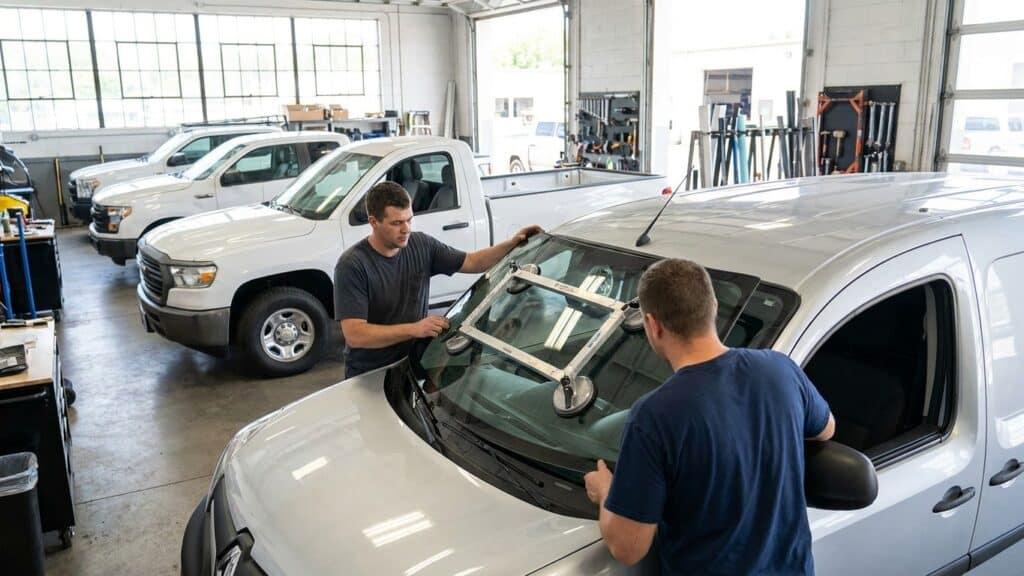
Mobile windshield replacement may reduce vehicle repositioning and the need for driver shuttles. Its value comes from matching service to a usable parking window, not assuming every location works. Weather, access, workspace, and vehicle requirements still affect the plan.
For a semi returning to Salt Lake City between loads, a planned stop may offer a service opportunity. Confirm the location and release requirements before committing the truck to its next assignment. An open calendar slot isn’t the same as a workable installation site.
Match the glass to the truck
Semi windshield replacement requires accurate vehicle and glass details. Trucks can have split or single-piece windshields, different mounting arrangements, and equipment that affects glass selection. A unit number alone isn’t enough to identify the replacement.
Send the vehicle identification number and details about heated glass, antennas, or windshield-mounted cameras when present. Original equipment manufacturer specifications, often shortened to OEM specifications, help guide the required configuration and procedures.
Customer feedback supplied for Two Bros Auto Glass describes efficient semi windshield replacement during a working route. Treat that as a reported service experience, not a turnaround commitment for your next truck.
Distinguish installation from readiness to drive
Installation time isn’t the whole service window. Consider adhesive safe-drive-away requirements and any required calibration before release. Your dispatch plan should use the technician’s instructions, not the moment the glass is fitted.
We offer mobile auto glass services across the entire state of Utah, and up into Evanston, Wyoming, and Idaho around the Utah border.
That reach supports planning beyond one depot, including fleets serving Lehi, Draper, Grantsville, and West Valley. Confirm the actual service location when booking rather than relying on a general coverage description.
Include ADAS in the replacement plan
Windshield-mounted cameras can be included in the replacement scope. Advanced driver assistance systems, or ADAS, use sensors and cameras for features such as lane warnings. Replacing glass can affect camera alignment, so manufacturer-required recalibration matters for safety.
Price comparisons should include the same scope. A glass-only estimate and an estimate including required ADAS calibration aren’t equivalent. Identify the vehicle’s equipment before approving the appointment.
Static and dynamic calibration have different needs
Static calibration uses positioned targets with the vehicle stationary in a controlled setup. The procedure may require specified lighting, floor conditions, and target distances. Dynamic calibration uses a prescribed drive under manufacturer-defined conditions so the system can establish its reference.
Some vehicles require both processes. Road conditions and other prerequisites can affect dynamic calibration. A convenient parking location doesn’t automatically meet every calibration requirement.
Customer feedback supplied for our business also highlights mobile windshield replacement coordinated with recalibration.
Keep completion records with the unit
Request documentation identifying the calibration performed and its reported completion status. Keep it with the windshield invoice and vehicle maintenance record. Warning lights or unusual assistance-system behavior after service warrant professional review.
Our Calibration Support Warranty provides a recheck and revision if needed when an issue appears after a calibration passes. It isn’t a general warranty for every ADAS component or function.
Make insurance and warranty details part of the budget
Insurance assistance may reduce administrative work, but it doesn’t determine coverage. Two Bros Auto Glass works with insurance carriers on paperwork and communication. Coverage, limits, and eligibility are determined by the issued policy and applicable state rules.
Confirm the applicable deductible and claim requirements before treating an expected payment as certain. Ask how required calibration will be addressed. Keep approval records attached to the same unit file as the final invoice.
Use warranty terms precisely
Under Two Bros Auto Glass’s Workmanship Guarantee, you must report service-related defects within 10 days. We inspect reported concerns and address issues related to our work. This workmanship protection is distinct from product coverage and the Calibration Support Warranty.
Our Lifetime Rock Chip Discount applies to the specific windshield replaced and to in-shop repairs. Don’t budget it as free future repairs or a mobile-service benefit. Its value depends on eligible damage and practical access to the shop.
Give one fleet contact responsibility for approvals and another clear route for driver reports. English and Spanish support can assist communication, but the unit identifier and service authorization still need to be consistent.
Frequently Asked Questions
Can Two Bros Auto Glass service trucks away from our depot?
Yes, Two Bros Auto Glass offers mobile auto glass repair and replacement throughout Utah, with service extending into Evanston and Idaho near the Utah border. Share the truck’s location, access details, and parking window when arranging service. The worksite and vehicle requirements determine whether the proposed location suits the work.
Does summer heat change how quickly we should report a chip?
Summer heat is a reason to report existing windshield damage promptly rather than wait for a scheduled maintenance visit. Send the damage location and vehicle details for assessment, and follow your fleet’s safety process before dispatch.
Does Two Bros Auto Glass provide after-hours fleet support?
Yes, Two Bros Auto Glass has an emergency after-hours line for fleets. Arrange the contact procedure through our main line before an urgent glass event occurs. Keep that procedure with dispatch instructions, alongside the unit details and approval contact. After-hours support doesn’t mean every replacement can begin immediately.
Will every fleet windshield replacement need ADAS calibration?
No, calibration requirements follow the vehicle’s equipment and manufacturer procedures. A windshield-mounted camera is a reason to check the requirement during scheduling. Some vehicles call for static calibration, dynamic calibration, or both. Confirm the required process before comparing estimates or setting the truck’s next departure.
How should we compare windshield replacement estimates?
To compare windshield replacement estimates, check that each includes the same glass configuration and required work. Review calibration, mobile service arrangements, and release instructions alongside price. Then calculate your own vehicle-transfer and waiting costs. A smaller invoice may not produce a lower total expense for the fleet.
The Bottom Line
-
Assess damage early instead of letting dispatch discover it at departure.
-
Compare total disruption costs, not just glass invoices.
-
Include required calibration and safe-drive-away instructions in the schedule.
-
Measure documented savings separately from estimated avoided costs.
Optimizing Fleet ROI works best as a repeatable maintenance process, starting with the damaged units already on your list.
Plan the next service before the next load
We recommend starting with your current damage reports, vehicle details, and upcoming parking windows. That information supports a practical assessment and a service plan built around your fleet’s actual work.
Call Two Bros Auto Glass at (801) 268-1204 to discuss windshield replacement, semi windshield replacement, and mobile service for your fleet.

- How Much Does Auto Window Tint Cost? What You Need to Know - October 21, 2026
- Mobile Auto Glass Service: Frequently Asked Questions - October 20, 2026
- A Fleet Manager’s Windshield Damage Checklist: What to Record Before Booking - October 20, 2026